Monday, March 7, 2011

Sensory Attributes of Oregano (Origanum vulgare) Chips


Researchers:
Merianne J. Manzana
Paul John P. Bauyon
Benzorade Albert B. Dimaala
Ronnel Salivio
Erwin Lopez
Research Adviser: Ma. Regaele A. Olarte 
Statement of the Problem
The aim of the study is to determine the sensory attributes of oregano chips.
Specifically, it seeks to answer the following questions:
1.  Can nutritional chips be produced from oregano leaves?
2.  Is there a significant difference between oregano chips and traditional nutritional chips in terms of its taste, texture, aroma, brittleness, color and shelf-life?
 Conceptual Framework


Gumamela (Hibiscus rosa-sinensis): An Alternative Flavoring For Ice Cream

Researcher:
Kate Jillian Merced Casanova

Research Adviser: Mrs. Ma. Regaele A. Olarte

Abstract
The research study was conducted to find the feasibility of the gumamela flowers as flavoring for ice cream. The presence of nutritional components in gumamela petals led the researcher to utilize it as flavoring to one of the most favorite dessert of young and old alike. It aimed to find an alternative ingredient that would be beneficial to the health of the people and would be acceptable as to its appearance, taste, texture, and aroma.
After the processes of preparing, cooking, mixing, blending and freezing of the gumamela ice cream, the researcher conducted a taste test. The experimental gumamela ice cream was labeled as A and a branded ice cream was labeled as B. Twenty eight (28) respondents graded the A and B from the scale of 1 to 5 wherein 1 the lowest and 5 is the highest. The results were tabulated and a t-test for two independent samples was used to determine if there is a significant difference between the experimental product and the branded ice cream in terms of the given parameters.
Results showed that there is no a significant difference between the experimental and the branded ice cream. 
Gumamela Petals

 Gumamela Syrup

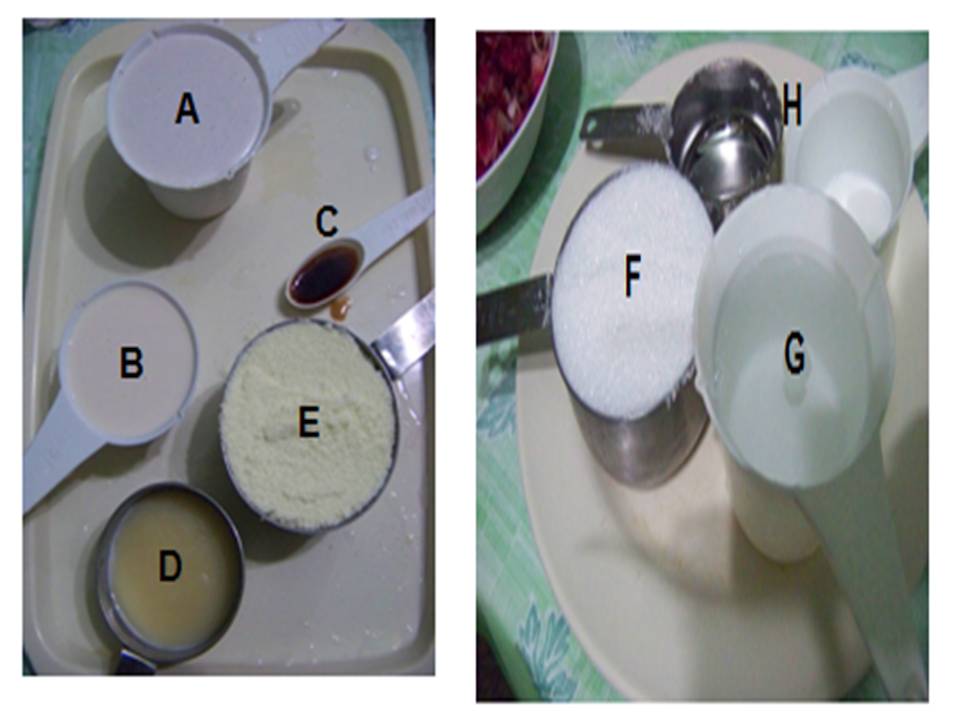
Ingredients Needed in Ice Cream Making


Thursday, March 3, 2011

Aloe Vera (Aloe Barbadensis) as an Effective Main Component of Marker Ink


Researchers:
  • Calusin, Mary Car V.
  • Daquioag, Kristine Joy M.
  • Samillano, Rhona Mae S.
  • Yap, Carmela A.
  • Yap, Jamie C.
Research Adviser: Mrs. Ma. Regaele A. Olarte


Statement of the Problem
            The researchers aimed to determine if Aloe barbandesis (Aloe Vera) extract can be a main component of a marker ink.
            Specifically, the researchers sought to study if there is a significant difference between the experimental product in terms of:
    1. Color
    2. Volatility
    3. Shelf life 
    4. Permanence
Discussion
           For the statistical analysis of the tests; since the calculated F-value 3.52 was less than the tabular F-value 4.38, there was no significant difference between the colors of the samples. There was also no significant difference between the shelf life of the samples since the calculated F-value 2.36 was less than the tabular F-value 4.38. However, there was a significant difference between the samples’ volatility since the calculated F-value 5.25 was greater than the tabular F-value 4.38. For the permanence of the samples, there was also a significant difference since the calculated F-value 8.29 was greater than the tabular F-value 4.38. The null hypothesis was supported in terms of the color and shelf-life of the samples. However, the permanence and volatility test validated the alternative hypothesis.

Sunday, February 27, 2011

The Effect of Euphorbia Hirta L. to Animal Intestinal Parasites

Researchers:
Mercader, Arlene L.
Mescallado, Kim Leianne M.
Montebon, Mariel S.
Sagana, Patricia Anne B.
Boquiren, Richard M.
Research Adviser:
Mrs. Ma. Regaele A. Olarte
Abstract
           Euphorbia Hirta L. or so-called Tawa tawa is a plant abundantly growing in almost all parts of the Philippines and is usually taken for granted due to its undiscovered scientific and medicinal importance. Recently, it was said that it is used in some parts of our country to increase the platelet count of dengue patients. Further studies were conducted to prove its effectiveness.
This research used Euphorbia Hirta L. but it was aimed at the decoction and utilization of the said plant as an animal purgative. Fifty milligrams of Euphorbia Hirta L. samples were gathered and the removal of unnecessary parts was done. Three different amounts of stem pieces which were about 1 cm. long were subjected to heat together with the 20 ml. of distilled water. The decocted products were cooled. Fifteen mice were used to test the decocted products and a commercialized purgative and were kept under observation for 12 hours in fifteen different shoe boxes.
The results were gathered by studying the feces of each mouse obtained from the shoe boxes after the said time. Unpaired t test was used for the statistical analysis. The results showed that there was a direct relationship between the amount of Euphorbia Hirta L. and the number of intestinal parasites purged and the effectiveness of each concentration depends on the amount of Euphorbia Hirta L.
Based on the findings obtained, the researchers concluded that Euphorbia Hirta L. is an effective animal purgative. The researchers recommended further experiments to strengthen this study and to discover the other medicinal uses and contributions of this plant.